
Kanoniv Cloud
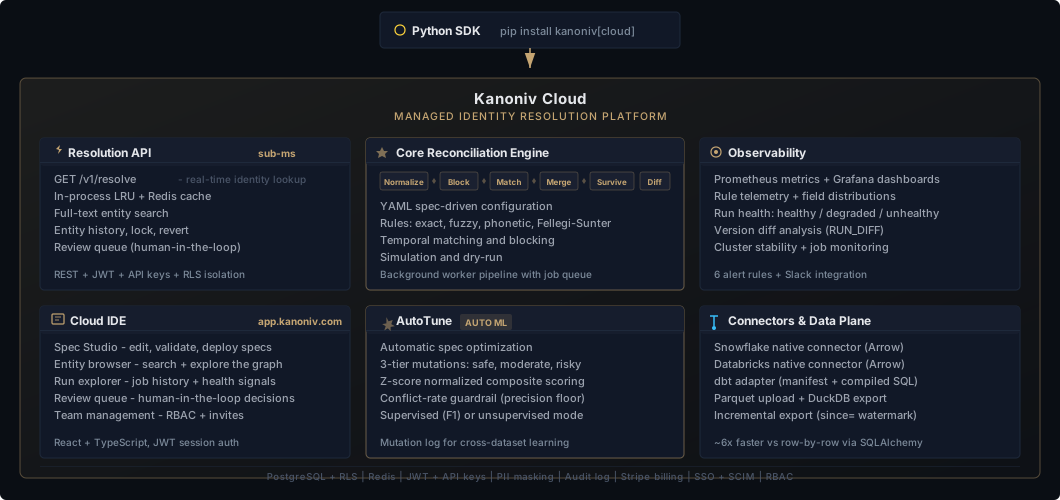
Kanoniv Cloud is the managed identity resolution platform. It persists your identity graph, scales to millions of records, provides health monitoring, and exposes a real-time resolution API. Everything the Core SDK does locally, Kanoniv Cloud does remotely with the capabilities that only a server can provide.
Why Cloud?
The Core SDK runs reconciliation in-process via a Rust engine. It is fast, requires no infrastructure, and is ideal for development, testing, and CI. The cloud SDK exists for when you need more.
What the cloud SDK adds:
- Persistent identity graph. Canonical entities, links, and audit history are stored in the database. Query them at any time, not just during a reconciliation run.
- Incremental resolution. Resolve records one at a time as they arrive via
POST /v1/resolve/realtime. The endpoint uses Fellegi-Sunter scoring against the live graph - no full re-reconciliation needed. Bulk lookups resolve up to 1,000 pairs in a single request via the Redis reverse index. - AutoTune. Automatically optimize your identity spec. AutoTune runs candidate mutations through the reconciliation engine, scores results with z-score normalization, and accepts improvements that pass a conflict-rate guardrail. Works unsupervised or with labeled pairs for F1-driven optimization.
- Cloud IDE. Spec Studio for editing and validating specs in the browser, an entity browser for exploring the identity graph, and a run explorer for inspecting job history and health.
- Run health and diagnostics. Every job returns a health assessment (
healthy/degraded/unhealthy) with signals and recommendations. The local engine returns raw results; the cloud interprets them. - Real-time resolution. Resolve an external ID to its canonical identity in a single API call (
client.resolve()), backed by a live graph that updates with every reconciliation. - Warehouse connectors. Native Snowflake and Databricks connectors stream data via Arrow for ~6x faster uploads. dbt adapter reads directly from compiled models.
- Entity lifecycle. Lock entities from merging, revert to prior states, view full change history, and manually override decisions through a review queue.
- Job orchestration. Submit reconciliation jobs, monitor progress, cancel in flight. Or use
kanoniv.cloud.reconcile()to do it all in one call with the samesourcesandspecyou use locally. - Audit trail. Every merge, split, override, and revert is recorded with full provenance.
When to use which:
Core (kanoniv.reconcile) | Cloud (kanoniv.cloud.reconcile) | |
|---|---|---|
| Runs where | In-process (Rust via PyO3) | Kanoniv API server |
| State | Ephemeral; results live in memory | Persistent; queryable via the API at any time |
| Scale | Bounded by local memory | Server-managed, horizontally scalable |
| Auth required | No | Yes (API key) |
| Incremental resolve | N/A | Real-time + bulk via Redis reverse index |
| AutoTune | kanoniv.autotune() (local) | Cloud IDE + API |
| IDE | N/A | Spec Studio, entity browser, run explorer |
| Connectors | CSV, JSON, pandas | + Snowflake, Databricks, dbt (Arrow fast path) |
| Health monitoring | N/A | Health status, flags, recommendations |
| Entity queries | N/A | Resolve, search, history, lock, revert |
| Best for | Dev, testing, CI, small datasets | Production, large datasets, ongoing resolution |
Platform Architecture
Same Package, Different Install
This is the API client portion of the kanoniv package. Install with pip install kanoniv[cloud] to get Client, AsyncClient, and kanoniv.cloud. For offline spec tooling, pip install kanoniv is sufficient. See Python SDK (Core).
Installation
pip install kanoniv[cloud]Requirements: Python 3.9+. Installs httpx for HTTP transport and pydantic for response models.
Connectors
Kanoniv Cloud reads from your warehouse using native connectors for fast, columnar Arrow transfers. Install the connector for your platform:
| Warehouse | Install | Connector | Connection String |
|---|---|---|---|
| Snowflake | pip install kanoniv[cloud,dataplane] | snowflake-connector-python | snowflake://user:pass@account/db |
| Databricks | pip install kanoniv[cloud,databricks] | databricks-sql-connector | databricks://token:dapi...@host?http_path=... |
Each extra installs pyarrow, duckdb, and the native connector. When present, kanoniv.cloud.reconcile() automatically detects the connection string scheme and uses the Arrow fast path (~6x faster than row-by-row).
# Snowflake
source = Source.from_warehouse(
    "crm", "ANALYTICS.CUSTOMERS",
    connection_string="snowflake://user:pass@account/ANALYTICS",
    primary_key="customer_id",
)

# Databricks
source = Source.from_warehouse(
    "billing", "main.default.invoices",
    connection_string="databricks://token:[email protected]?http_path=/sql/1.0/warehouses/abc",
    primary_key="invoice_id",
)
Without a connector extra installed, kanoniv.cloud.reconcile() still works but falls back to row-by-row iteration via SQLAlchemy.
Quick Start
Go from raw data to a live identity graph in one script.
Sample Data
Grab the sample datasets from the test-dataset/ directory — 100 Salesforce contacts and 100 Stripe customers with ~40 overlapping identities.
import kanoniv
from kanoniv import Source, Spec

# 1. Define your sources — second arg is the path to the CSV file on disk
crm = Source.from_csv("salesforce", "test-dataset/sf_contacts.csv", primary_key="sf_id")
billing = Source.from_csv("stripe", "test-dataset/stripe_customers.csv", primary_key="cus_id")

# 2. Load your identity spec
spec = Spec.from_file("specs/customer.yaml")

# 3. Reconcile on the cloud
with kanoniv.cloud.reconcile([crm, billing], spec, api_key="kn_...") as result:
    print(result.summary())
    # Cloud Reconciliation — job a1b2c3d4-...
    #   Status:          completed
    #   Health:          healthy
    #   Input entities:  12,400
    #   Canonicals:      8,230
    #   Merge rate:      33.6%
The identity graph is now live. Query it at any time:
from kanoniv import Client

with Client(api_key="kn_...") as client:
    # Resolve a Salesforce contact to its canonical identity
    result = client.resolve(system="salesforce", external_id="003A000001abc")
    print(result["canonical_id"])  # "c7e2f9a1-..."

    # See every linked record across all systems
    linked = client.entities.get_linked(result["canonical_id"])
    for record in linked["linked"]:
        print(f"  {record['source_name']}: {record['external_id']}")
    # salesforce: 003A000001abc
    # stripe: cus_N4x8Kj

    # Search by email
    results = client.entities.search(q="[email protected]")
    for entity in results["data"]:
        print(entity["id"], entity["data"]["email"])
Real-World Scenarios
These are production patterns. Each scenario uses the full cloud SDK to solve a real identity resolution problem at scale.
Multi-Source Identity Stitching
The most common use case: you have customer data scattered across CRM, billing, support, and marketing systems. Each system has its own ID. The cloud builds a persistent identity graph that unifies them.
# specs/customer.yaml
api_version: kanoniv/v1
identity_version: customer-v1
entity:
  name: customer
sources:
  - name: salesforce
    attributes:
      email_address: email
      full_name: name
      phone: phone
  - name: stripe
    attributes:
      billing_email: email
      customer_name: name
  - name: zendesk
    attributes:
      requester_email: email
      requester_name: name
rules:
  - name: email_exact
    type: exact
    field: email
    weight: 1.0
  - name: name_fuzzy
    type: similarity
    field: name
    algorithm: jaro_winkler
    threshold: 0.88
    weight: 0.6
decision:
  thresholds:
    match: 0.85
review: 0.65import kanoniv
from kanoniv import Source, Spec
spec = Spec.from_file("specs/customer.yaml")
sources = [
Source.from_csv("salesforce", "test-dataset/sf_contacts.csv", primary_key="sf_id"),
Source.from_csv("stripe", "test-dataset/stripe_customers.csv", primary_key="cus_id"),
Source.from_csv("zendesk", "data/zd_tickets.csv", primary_key="ticket_id"),
]
with kanoniv.cloud.reconcile(sources, spec, api_key="kn_...") as result:
print(result.summary())
# Cloud Reconciliation — job a1b2c3d4-...
# Status: completed
# Duration: 12400ms
# Health: healthy
# Input entities: 84,230
# Canonicals: 31,847
# Links: 84,230
# Merge rate: 62.2%
# Every source entity now maps to a canonical customer
df = result.to_pandas()
print(f"{len(df)} unified customers from {84_230} source records")
# Which canonical has the most linked records?
linked = df.sort_values("link_count", ascending=False).head(1)
print(f"Largest cluster: {linked.iloc[0]['id']} with {linked.iloc[0]['link_count']} records")After reconciliation, the identity graph is live. Resolve any source ID to its canonical customer at any time:
from kanoniv import Client

with Client(api_key="kn_...") as client:
    # Salesforce contact → canonical customer
    result = client.resolve(system="salesforce", external_id="003A000001abc")
    print(result["canonical_id"])  # "c7e2f9a1-..."

    # See all linked records across all systems
    linked = client.entities.get_linked(result["canonical_id"])
    for record in linked["linked"]:
        print(f"  {record['source_name']}: {record['external_id']}")
    # salesforce: 003A000001abc
    # stripe: cus_N4x8Kj
    # zendesk: req_88291
Batch Processing at Scale
When you have millions of records, the cloud handles the heavy lifting. The cloud.reconcile() function batches data uploads automatically (5,000 records per request), but for very large datasets you control the pipeline directly for progress tracking and resilience.
import time
from kanoniv import Client, Source, Spec

spec = Spec.from_file("specs/customer.yaml")
client = Client(api_key="kn_...", timeout=60.0, max_retries=4)

# 1. Upload the spec
client.specs.ingest(spec.raw, compile=True)

# 2. Pull 5M records from the warehouse in streaming batches
source = Source.from_warehouse(
    "crm",
    "analytics.crm_contacts",
    connection_string="snowflake://user:pass@account/db/schema",
)

# 3. Upload in controlled batches with progress
BATCH = 1000
entities = source.to_entities("customer")
total = len(entities)
uploaded = 0

for i in range(0, total, BATCH):
    batch = entities[i : i + BATCH]
    client.ingest("crm", batch)
    uploaded += len(batch)
    if uploaded % 50_000 == 0:
        print(f"  Uploaded {uploaded:,} / {total:,} ({uploaded/total:.0%})")

print(f"Uploaded {total:,} records. Submitting reconciliation job...")

# 4. Submit the job
job = client.jobs.run("reconciliation")
job_id = job["id"]

# 5. Poll with progress
while True:
    status = client.jobs.get(job_id)
    state = status["status"]
    if state in ("completed", "failed", "cancelled"):
        break
    print(f"  Job {job_id}: {state}")
    time.sleep(5)

if state == "failed":
    print(f"Job failed: {status.get('error')}")
elif state == "completed":
    stats = status.get("result", {}).get("stats", {})
    print(f"Done. {stats.get('canonicals_created', 0):,} canonical identities created.")

client.close()
Data Warehouse to Kanoniv
Connect directly to Snowflake, BigQuery, Postgres, Databricks, or any SQLAlchemy-compatible warehouse. The warehouse adapter streams rows without loading the entire table into memory.
import kanoniv
from kanoniv import Source, Spec

spec = Spec.from_file("specs/patient.yaml")

# Snowflake
patients = Source.from_warehouse(
    "hospital_emr",
    "raw.emr_patients",
    connection_string="snowflake://user:pass@acct/HEALTHCARE/RAW",
)

# Databricks
claims = Source.from_warehouse(
    "insurance_claims",
    "main.default.member_records",
    connection_string="databricks://token:[email protected]?http_path=/sql/1.0/warehouses/abc",
)

# Postgres (your own operational DB)
support = Source.from_warehouse(
    "support_tickets",
    "public.tickets",
    connection_string="postgresql://user:pass@db-host:5432/support",
)

with kanoniv.cloud.reconcile(
    [patients, claims, support],
    spec,
    api_key="kn_...",
    timeout=600.0,      # large datasets need more time
    poll_interval=10.0,  # check less frequently
) as result:
    print(result.summary())

    if result.health_status != "healthy":
        print(f"Warnings: {result.health_flags}")

    df = result.to_pandas()
    print(f"{len(df)} canonical patients resolved from 3 warehouse sources")
dbt users: If your models are in dbt, pull directly from your compiled models:
from kanoniv import Source

# Reads the dbt manifest to find the compiled SQL, then streams results
customers = Source.from_dbt(
    "dbt_customers",
    model="stg_customers",
    manifest_path="target/manifest.json",
    connection_string="snowflake://user:pass@acct/ANALYTICS/PUBLIC",
)
Reverse ETL: Write Canonical IDs Back
After reconciliation, the canonical IDs need to flow back into your systems. Pull the identity graph from Kanoniv and write it to your warehouse, CRM, or any downstream system.
Write to your data warehouse:
import kanoniv
from kanoniv import Source, Spec
from sqlalchemy import create_engine, text

spec = Spec.from_file("specs/customer.yaml")
sources = [
    Source.from_warehouse("crm", "raw.sf_contacts", connection_string="snowflake://..."),
    Source.from_warehouse("billing", "raw.stripe_customers", connection_string="snowflake://..."),
]

# 1. Reconcile
with kanoniv.cloud.reconcile(sources, spec, api_key="kn_...") as result:
    df = result.to_pandas()

# 2. Write canonical mappings back to the warehouse
engine = create_engine("snowflake://user:pass@acct/ANALYTICS/PUBLIC")
with engine.begin() as conn:
    conn.execute(text("TRUNCATE TABLE identity.canonical_mappings"))

# source_name, external_id, canonical_id — one row per link
mapping_df = df[["source_name", "external_id", "id"]].rename(columns={"id": "canonical_id"})
mapping_df.to_sql("canonical_mappings", engine, schema="identity", if_exists="append", index=False)

print(f"Wrote {len(mapping_df):,} canonical mappings to Snowflake")
Update your CRM via API:
from kanoniv import Client
import requests

with Client(api_key="kn_...") as client:
    # For each Salesforce contact, stamp the canonical ID
    sf_entities = client.entities.search(entity_type="customer", limit=100)
    for entity in sf_entities["data"]:
        linked = client.entities.get_linked(entity["id"])
        for record in linked["linked"]:
            if record["source_name"] == "salesforce":
                # Write canonical_id back to Salesforce
                requests.patch(
                    f"https://your-instance.salesforce.com/services/data/v58.0/sobjects/Contact/{record['external_id']}",
                    json={"Canonical_ID__c": entity["id"]},
                    headers={"Authorization": "Bearer <sf_token>"},
                )
Real-Time Resolution Pipeline
Resolve identities as events arrive. This pattern works with webhooks, message queues, or any event-driven architecture.
The POST /v1/resolve/realtime endpoint uses Fellegi-Sunter probabilistic scoring - the same compiled FS plan from your batch spec - to match incoming records against the existing identity graph. It generates blocking keys, retrieves candidates, and applies the full scoring pipeline with normalizers (email, phone, name, nickname, domain) and comparators (exact, jaro_winkler, levenshtein, soundex, metaphone, cosine).
Two-threshold decision logic:
match_threshold(from your spec) - for linking a new record to an existing entity (lower bar)merge_threshold(defaults tomatch * 1.5) - for merging existing entities when a new record bridges them (higher bar)
If no FS plan exists yet, the endpoint falls back to exact email/phone matching (backwards compatible).
FastAPI webhook endpoint:
from fastapi import FastAPI, Request
from kanoniv import Client

app = FastAPI()
client = Client(api_key="kn_...")

@app.post("/webhook/crm")
async def handle_crm_event(request: Request):
    payload = await request.json()

    # Real-time resolve with Fellegi-Sunter scoring.
    # Ingests the record, scores against existing canonical entities,
    # and links to an existing entity or creates a new one.
    result = client.resolve_rt.realtime(
        source_name="salesforce",
        external_id=payload["contact_id"],
        data={
            "email": payload["email"],
            "name": payload["name"],
            "phone": payload.get("phone", ""),
        },
    )

    return {
        "entity_id": result["entity_id"],
        "is_new": result["is_new"],
        "confidence": result["confidence"],
    }


@app.post("/webhook/stripe")
async def handle_stripe_event(request: Request):
    event = await request.json()
    if event["type"] == "customer.created":
        customer = event["data"]["object"]

        result = client.resolve_rt.realtime(
            source_name="stripe",
            external_id=customer["id"],
            data={
                "email": customer["email"],
                "name": customer.get("name", ""),
            },
        )

        if not result["is_new"]:
            linked = client.entities.get_linked(result["entity_id"])
            print(f"Stripe {customer['id']} linked to {len(linked['linked_entities'])} records")
            print(f"  Confidence: {result['confidence']}")

    return {"ok": True}
Bulk resolve - look up many source IDs at once:
from kanoniv import Client

with Client(api_key="kn_...") as client:
    result = client.resolve_rt.bulk([
        {"source": "salesforce", "id": "003A000001abc"},
        {"source": "stripe", "id": "cus_N4x8Kj"},
        {"source": "zendesk", "id": "req_88291"},
    ])

    print(f"Resolved: {result['resolved']}, Not found: {result['not_found']}")
    for r in result["results"]:
        if r["found"]:
            print(f"  {r['source']}:{r['id']} -> {r['entity_id']}")
Async batch resolution with concurrency:
import asyncio
from kanoniv import AsyncClient

async def resolve_realtime_batch(records: list[dict]):
    """Resolve a batch of records concurrently. Useful for processing
    a queue of events that arrived while offline."""
    async with AsyncClient(api_key="kn_...") as client:
        tasks = [
            client.resolve_rt.realtime(
                source_name=item["source"],
                external_id=item["id"],
                data=item["data"],
            )
            for item in records
        ]
        results = await asyncio.gather(*tasks, return_exceptions=True)

        resolved = 0
        for item, result in zip(records, results):
            if isinstance(result, Exception):
                print(f"  Failed {item['source']}:{item['id']}: {result}")
            else:
                resolved += 1

        print(f"Resolved {resolved}/{len(records)} identities")
        return results

# Process a backlog of events
backlog = [
    {"source": "salesforce", "id": "003A000001abc", "data": {"email": "[email protected]"}},
    {"source": "stripe", "id": "cus_N4x8Kj", "data": {"email": "[email protected]"}},
    {"source": "zendesk", "id": "req_88291", "data": {"email": "[email protected]"}},
]
asyncio.run(resolve_realtime_batch(backlog))
For large batches where you already have source+id pairs (and don't need to ingest new data), resolve_rt.bulk() is more efficient than calling resolve_rt.realtime() in a loop - it resolves up to 1000 lookups in a single request via the Redis reverse index.
Human-in-the-Loop Review Queue
When the engine finds a match that scores between the auto-merge and rejection thresholds, it lands in the review queue. Build a review workflow for your operations team.
from kanoniv import Client

with Client(api_key="kn_...") as client:
    # 1. Fetch pending reviews
    pending = client.reviews.list(limit=50)
    print(f"{len(pending)} reviews pending")

    for review in pending:
        entity_a = client.entities.get(review["entity_a_id"])
        entity_b = client.entities.get(review["entity_b_id"])

        print(f"\n--- Review (score: {review['score']:.2f}) ---")
        print(f"  A: {entity_a['data'].get('name', '?')} <{entity_a['data'].get('email', '?')}>")
        print(f"     Source: {entity_a.get('source_name')}")
        print(f"  B: {entity_b['data'].get('name', '?')} <{entity_b['data'].get('email', '?')}>")
        print(f"     Source: {entity_b.get('source_name')}")

        # In a real app, this comes from your UI or Slack bot
        decision = input("  Merge or reject? [m/r/s(kip)]: ").strip().lower()
        if decision == "m":
            client.reviews.decide(
                entity_a_id=review["entity_a_id"],
                entity_b_id=review["entity_b_id"],
                decision="merge",
                reason="Confirmed same person by ops team",
            )
            print("  -> Merged")
        elif decision == "r":
            client.reviews.decide(
                entity_a_id=review["entity_a_id"],
                entity_b_id=review["entity_b_id"],
                decision="reject",
                reason="Different people despite similar data",
            )
            print("  -> Rejected")
        else:
            print("  -> Skipped")
Force-merge or force-split when you know better than the engine:
with Client(api_key="kn_...") as client:
    # These two records are definitely the same person
    client.overrides.create(
        override_type="force_merge",
        entity_a_id="uuid-a",
        entity_b_id="uuid-b",
    )

    # These were wrongly merged — split them apart
    client.overrides.create(
        override_type="force_split",
        entity_a_id="uuid-c",
        entity_b_id="uuid-d",
    )

    # Check the audit trail to see what happened
    trail = client.audit.entity_trail("uuid-a")
    for event in trail:
        print(f"  {event['event_type']} at {event['created_at']}")
Cloud Reconciliation
kanoniv.cloud.reconcile() accepts the same sources and spec as the local reconcile(), but runs the job on the Kanoniv API. One function call handles everything: spec upload, data upload, job submission, polling, and result extraction.
import kanoniv
from kanoniv import Source, Spec

spec = Spec.from_file("specs/customer.yaml")
sources = [
    Source.from_csv("crm", "data/crm_contacts.csv"),
    Source.from_csv("billing", "data/billing_accounts.csv"),
]

# Local (runs in-process via Rust engine)
local_result = kanoniv.reconcile(sources, spec)

# Cloud (runs on the Kanoniv API, same inputs)
cloud_result = kanoniv.cloud.reconcile(sources, spec, api_key="kn_...")
Parameters
| Parameter | Type | Default | Description |
|---|---|---|---|
sources | list[Source] | required | Data sources to reconcile |
spec | Spec | required | Identity spec defining rules and thresholds |
client | Client | None | None | Existing client instance (skips creating one) |
api_key | str | None | None | API key (used when client is not provided) |
base_url | str | "https://api.kanoniv.com" | API base URL |
poll_interval | float | 2.0 | Seconds between job-status polls |
timeout | float | 300.0 | Maximum seconds to wait for job completion |
What Happens Under the Hood
When you call kanoniv.cloud.reconcile(), five steps run automatically:
1. Build or reuse client. If you pass a client, it is used directly. Otherwise a new Client is created from api_key and base_url.
2. Upload and compile the spec. The raw YAML from spec.raw is sent to the server via client.specs.ingest(spec.raw, compile=True). The server validates, compiles, and stores the spec version.
3. Map attributes and collect entities. For each source, source.to_entities(entity_type) converts rows into entity dicts. If the spec defines attribute mappings (e.g. email_address in source maps to email canonical), they are applied so all sources share a common schema.
4. Upload entities in batches. Entities are uploaded per source in batches of 500 via client.ingest(source_name, batch). A source with 2,000 rows sends 4 requests.
5. Submit job, poll until done. A reconciliation job is submitted via client.jobs.run("reconciliation"). The function polls client.jobs.get(job_id) every poll_interval seconds until the job completes, fails, is cancelled, or timeout is reached.
# You can do the same steps manually if you need more control:
from kanoniv import Client, Source, Spec

spec = Spec.from_file("specs/customer.yaml")
source = Source.from_csv("crm", "data/contacts.csv")

with Client(api_key="kn_...", base_url="https://api.kanoniv.com") as client:
    # Step 2: upload spec
    client.specs.ingest(spec.raw, compile=True)

    # Step 4: upload entities
    entities = source.to_entities("contact")
    for i in range(0, len(entities), 500):
        client.ingest("crm", entities[i:i+500])

    # Step 5: run and poll
    job = client.jobs.run("reconciliation")
    # ... poll client.jobs.get(job["id"]) until completed
CloudReconcileResult
The cloud result contains aggregate summaries returned by the server. Raw clusters and golden records are persisted server-side and accessible at any time via the entity APIs.
Fields
| Field | Type | Description |
|---|---|---|
job_id | str | Unique identifier of the reconciliation job |
status | str | Final job status ("completed") |
canonicals_created | int | Number of canonical identities produced |
links_created | int | Number of entity-to-canonical links created |
duration_ms | int | Server-side execution time in milliseconds |
identity_summary | dict | Full summary dict from the server (input counts, output counts, clustering, match quality, survivorship, stability, health flags) |
run_health | dict | Health assessment dict (status, signals, recommendations) |
result = kanoniv.cloud.reconcile(sources, spec, api_key="kn_...")

print(result.job_id)             # "a1b2c3d4-..."
print(result.canonicals_created) # 1234
print(result.links_created)      # 5678
print(result.duration_ms)        # 4200

# Access the full server response dicts
print(result.identity_summary.keys())
# dict_keys(["input", "output", "clustering", "match_quality", "survivorship", "stability", "health_flags"])

print(result.run_health)
# {"status": "healthy", "signals": [...], "recommendations": [...]}
Properties
Computed from identity_summary and run_health for convenience.
| Property | Type | Source | Description |
|---|---|---|---|
cluster_count | int | identity_summary.output.canonical_identities | Number of canonical identities |
merge_rate | float | identity_summary.output.merge_rate | Fraction of entities merged (0.0 to 1.0) |
match_quality | dict | identity_summary.match_quality | Breakdown of accepted, rejected, and uncertain matches |
health_status | str | run_health.status | "healthy", "degraded", or "unhealthy" |
health_flags | list[str] | identity_summary.health_flags | Warning labels (e.g. "low_match_rate", "high_cluster_size") |
result = kanoniv.cloud.reconcile(sources, spec, api_key="kn_...")

print(result.cluster_count)  # 1234
print(result.merge_rate)     # 0.42
print(result.health_status)  # "healthy"
print(result.health_flags)   # ["low_match_rate"]
print(result.match_quality)  # {"accepted_matches": 120, "rejected_matches": 8, ...}

# Use in conditional logic
if result.health_status != "healthy":
    print(f"Run degraded: {result.health_flags}")
Methods
summary() returns a human-readable string of the run.
print(result.summary())
# Cloud Reconciliation — job a1b2c3d4-...
#   Status:          completed
#   Duration:        4200ms
#   Health:          healthy
#   Input entities:  2000
#   Canonicals:      1234
#   Links:           5678
#   Merge rate:      42.0%
#   Match quality:   {"accepted_matches": 120, "rejected_matches": 8}
#   Health flags:    low_match_rate
to_pandas() fetches canonical entities from the API with automatic pagination and returns a pandas DataFrame. Requires pip install pandas.
df = result.to_pandas()
print(df.shape)       # (1234, 8)
print(df.columns)     # ["id", "entity_type", "data", "source_name", ...]
print(df.head())

# Filter or export
df[df["entity_type"] == "contact"].to_csv("contacts.csv")
close() closes the underlying HTTP connection if the result created it. Called automatically when used as a context manager. No-op if you passed your own Client.
Context Manager
CloudReconcileResult is a context manager. When you use api_key (no explicit client), the result owns the underlying connection and close() cleans it up:
import kanoniv

with kanoniv.cloud.reconcile(sources, spec, api_key="kn_...") as result:
    print(result.summary())
    df = result.to_pandas()
# Connection closed automatically
For scripts where cleanup is not critical, you can skip the with block:
result = kanoniv.cloud.reconcile(sources, spec, api_key="kn_...")
df = result.to_pandas()
Reusing an Existing Client
Pass a Client to share one connection across multiple calls. The result does not own or close a client you provide:
from kanoniv import Client
import kanoniv

with Client(api_key="kn_...", base_url="https://api.kanoniv.com") as client:
    result = kanoniv.cloud.reconcile(sources, spec, client=client)
    df = result.to_pandas()

    # Run a second reconciliation on the same connection
    result2 = kanoniv.cloud.reconcile(other_sources, other_spec, client=client)

    # Query entities directly
    entity = client.entities.get(df.iloc[0]["id"])
Error Handling
| Exception | When |
|---|---|
ValueError | Neither client nor api_key provided |
TimeoutError | Job did not complete within timeout seconds. The error message includes the job_id so you can check status later. |
RuntimeError | Job failed or was cancelled on the server. The error message includes the server error or cancellation notice. |
import kanoniv

try:
    result = kanoniv.cloud.reconcile(sources, spec, api_key="kn_...")
except TimeoutError as e:
    # Extract the job_id from the message and check later
    print(e)
    # "Cloud reconciliation job abc-123 did not complete within 300.0s.
    #  Check status with client.jobs.get('abc-123')."
except RuntimeError as e:
    # Server-side failure
    print(e)
    # "Cloud reconciliation job abc-123 failed: out of memory"
For long-running jobs, increase timeout or lower poll_interval:
result = kanoniv.cloud.reconcile(
    sources, spec,
    api_key="kn_...",
    timeout=600.0,       # wait up to 10 minutes
    poll_interval=5.0,   # check every 5 seconds
)
Autodetect
The autodetect endpoint profiles your ingested data and returns detected identity signals, blocking keys, and an inferred entity type. Use it to understand what the engine sees in your data before writing a spec or bootstrapping an identity plan.
Endpoint: POST /v1/autodetect
Request
| Field | Type | Required | Default | Description |
|---|---|---|---|---|
sample_size | int | No | 500 | Number of rows to sample for profiling |
bootstrap | bool | No | false | If true, generate and persist an identity plan from detected signals |
identity_version | string | No | - | Version label for the bootstrapped plan (used when bootstrap is true) |
entity_type | string | No | - | Entity type hint: "person", "company", "product", "transaction", or "healthcare". If omitted, the profiler infers the entity type from the data. |
import httpx

resp = httpx.post(
    "https://api.kanoniv.com/v1/autodetect",
    headers={"X-API-Key": "kn_..."},
    json={"sample_size": 1000},
)
result = resp.json()
print(result["inferred_entity_type"])  # "product"
print(result["identity_signals"])       # ["sku", "upc", "product_name", "brand"]
Response
| Field | Type | Description |
|---|---|---|
total_records | int | Total records in the tenant's data |
rows_sampled | int | Number of rows actually sampled |
sources | list[str] | Source names found in the sampled data |
columns | list[object] | Per-column profiling results (signal, uniqueness, null_rate, cardinality, sample_values) |
blocking_keys | list[list[str]] | Inferred blocking key combinations |
identity_signals | list[str] | Detected identity-relevant signals (e.g. ["email", "phone", "full_name"]) |
inferred_entity_type | string | The entity type inferred from the data: "person", "company", "product", "transaction", or "healthcare" |
bootstrapped_version | string | null | Version label of the bootstrapped plan, if bootstrap was true |
The inferred_entity_type field determines which signal catalog the profiler uses. Each entity type has its own set of expected signals and blocking key templates. See Entity Type Detection for more on how inference works.
Entity Type Hint
When you provide an entity_type in the request, the profiler skips inference and uses that type's signal catalog directly. This is useful when:
- Your data contains signals for multiple entity types and you want to force a specific interpretation
- The inferred type is wrong (e.g. a dataset with both person names and product SKUs)
- You want to use a specific set of blocking key templates
resp = httpx.post(
    "https://api.kanoniv.com/v1/autodetect",
    headers={"X-API-Key": "kn_..."},
    json={"entity_type": "healthcare", "sample_size": 500},
)
Bootstrap
When bootstrap is true, the endpoint generates a full identity plan from the detected signals and persists it. The plan includes matching rules, blocking keys, and Fellegi-Sunter scoring parameters calibrated to the data distribution. The bootstrapped_version field in the response contains the version label.
resp = httpx.post(
    "https://api.kanoniv.com/v1/autodetect",
    headers={"X-API-Key": "kn_..."},
    json={"bootstrap": true, "identity_version": "v1"},
)
print(resp.json()["bootstrapped_version"])  # "v1"
Authentication
from kanoniv import Client

# API key (recommended for programmatic use)
client = Client(api_key="kn_abc123", base_url="https://api.kanoniv.com")

# JWT bearer token (for interactive sessions)
client = Client(access_token="eyJ...", base_url="https://api.kanoniv.com")
Context Manager
Both sync and async clients support context managers for automatic cleanup:
from kanoniv import Client

with Client(api_key="kn_...", base_url="https://api.kanoniv.com") as client:
    result = client.resolve(system="stripe", external_id="cus_123")
Async Usage
All methods are available in both sync and async variants:
import asyncio
from kanoniv import AsyncClient

async def main():
    async with AsyncClient(api_key="kn_...", base_url="https://api.kanoniv.com") as client:
        result = await client.resolve(system="crm", external_id="sf_123")
        entities = await client.entities.search(q="jane")
        await client.ingest("src-id", records=[{"id": "1", "name": "Jane"}])  # upload for resolution

asyncio.run(main())
Configuration
from kanoniv import Client

client = Client(
    api_key="kn_...",                            # API key authentication
    base_url="https://api.kanoniv.com",          # default; override for self-hosted
    timeout=30.0,                                # request timeout in seconds (default)
    max_retries=2,                               # retry on 429/5xx errors (default)
)| Parameter | Type | Default | Description |
|---|---|---|---|
api_key | str | None | None | API key (sets X-API-Key header) |
access_token | str | None | None | JWT bearer token (alternative to api_key) |
base_url | str | "https://api.kanoniv.com" | API base URL. Override for self-hosted deployments. |
timeout | float | 30.0 | Request timeout in seconds |
max_retries | int | 2 | Number of retries on transient errors |
The client retries on transient errors (408, 429, 502, 503, 504) with exponential backoff. The Retry-After header is respected for 429 responses.
API Reference
Every method below is available on both Client (sync) and AsyncClient (async, prefix calls with await). All methods return parsed JSON as dict or list[dict] unless noted otherwise. HTTP errors raise typed exceptions (see Error Handling).
Top-Level Methods
These are convenience methods on the client itself, not on a sub-resource.
client.resolve()
Resolve an identity by system + external ID, or search by free-text query.
| Parameter | Type | Required | Description |
|---|---|---|---|
system | str | None | no | Source system name (e.g. "salesforce") |
external_id | str | None | no | External ID within the system |
query | str | None | keyword-only | Free-text search (e.g. an email address) |
Returns: dict with canonical_id, matched entity data, and confidence score.
Endpoint: GET /v1/resolve
# By system + external ID
result = client.resolve(system="salesforce", external_id="003xxx")
print(result["canonical_id"])

# By free-text query
result = client.resolve(query="[email protected]")
client.ingest()
Upload records for cloud reconciliation. Used internally by cloud.reconcile() or directly for batch pipelines.
| Parameter | Type | Required | Description |
|---|---|---|---|
source_id | str | yes | Source UUID or name |
records | list[dict] | yes | List of record dicts to upload |
Returns: dict with upload status and count.
Endpoint: POST /v1/ingest/webhook/{source_id}
client.ingest("source-uuid", records=[
    {"id": "ext_1", "name": "John", "email": "[email protected]"},
    {"id": "ext_2", "name": "Jane", "email": "[email protected]"},
])
client.ingest_file()
Upload a file for cloud reconciliation.
| Parameter | Type | Required | Description |
|---|---|---|---|
source_id | str | yes | Source UUID or name |
path | str | Path | yes | Path to the file (string or pathlib.Path) |
Returns: dict with processing status and record count.
Endpoint: POST /v1/ingest/file/process
client.ingest_file("source-uuid", path="data/contacts.csv")

from pathlib import Path
client.ingest_file("source-uuid", path=Path("data/contacts.csv"))
client.ingest_parquet()
Upload a Parquet file for bulk ingestion. Uses content hashing for idempotent ingest - unchanged records are skipped. This is the upload method used by the Arrow data plane.
| Parameter | Type | Required | Description |
|---|---|---|---|
source_name | str | yes | Source system name |
path | str | Path | yes | Path to a local .parquet file |
entity_type | str | no | Entity type label (default: "entity") |
entity_type is keyword-only.
Returns: dict with new, updated, and unchanged counts.
Endpoint: POST /v1/ingest/parquet
result = client.ingest_parquet("crm", "data/crm.parquet", entity_type="customer")
print(f"New: {result['new']}, Updated: {result['updated']}, Unchanged: {result['unchanged']}")

from pathlib import Path
client.ingest_parquet("billing", Path("data/billing.parquet"))
client.stats()
Get dashboard statistics.
Returns: dict with entity counts, source counts, and job summaries.
Endpoint: GET /v1/stats
stats = client.stats()
print(f"{stats['total_canonical_entities']} canonical entities")
Entities: client.entities
Manage canonical entities, search the identity graph, view history, and control entity lifecycle.
entities.search()
Search entities with optional filters and pagination.
| Parameter | Type | Required | Description |
|---|---|---|---|
q | str | None | no | Free-text search query |
entity_type | str | None | no | Filter by entity type (e.g. "contact") |
limit | int | None | no | Max results to return |
offset | int | None | no | Number of results to skip (for pagination) |
All parameters are keyword-only.
Returns: dict with data (list of entities) and pagination metadata.
Endpoint: GET /v1/entities
page = client.entities.search(q="[email protected]", entity_type="contact", limit=20, offset=0)
for entity in page["data"]:
    print(entity["id"], entity["data"]["email"])
entities.get()
Get a canonical entity by ID.
| Parameter | Type | Required | Description |
|---|---|---|---|
id | str | yes | Canonical entity UUID |
Returns: dict with entity fields, data, source links, and metadata.
Endpoint: GET /v1/canonical/{id}
entity = client.entities.get("canonical-uuid")
print(entity["data"]["name"])
entities.get_linked()
Get a canonical entity with all linked external entities.
| Parameter | Type | Required | Description |
|---|---|---|---|
id | str | yes | Canonical entity UUID |
Returns: dict with the canonical entity and a linked array of source entities.
Endpoint: GET /v1/canonical/{id}/linked
result = client.entities.get_linked("canonical-uuid")
for linked in result["linked"]:
    print(f"  {linked['source_name']}: {linked['external_id']}")
entities.get_linked_bulk()
Fetch linked entities for multiple canonical IDs in a single request. Accepts up to 1000 IDs. Used by the Arrow data plane to build crosswalk tables efficiently.
| Parameter | Type | Required | Description |
|---|---|---|---|
entity_ids | list[str] | yes | Canonical entity UUIDs (max 1000) |
Returns: dict with results mapping each entity ID to its linked records.
Endpoint: POST /v1/entities/linked/bulk
result = client.entities.get_linked_bulk(["uuid-1", "uuid-2", "uuid-3"])
for entity_id, linked in result["results"].items():
    for record in linked:
        print(f"  {entity_id} -> {record['source_name']}: {record['external_id']}")
entities.history()
Get the change history of an entity.
| Parameter | Type | Required | Description |
|---|---|---|---|
id | str | yes | Entity UUID |
Returns: dict with a list of audit events (merges, splits, reverts, data changes).
Endpoint: GET /v1/entities/{id}/history
history = client.entities.history("entity-uuid")
for event in history["events"]:
    print(f"{event['event_type']} at {event['created_at']}")
entities.lock()
Lock an entity to prevent further merging.
| Parameter | Type | Required | Description |
|---|---|---|---|
id | str | yes | Entity UUID |
Returns: dict confirming the lock status.
Endpoint: POST /v1/entities/{id}/lock
client.entities.lock("entity-uuid")entities.revert()
Revert an entity to a prior state.
| Parameter | Type | Required | Description |
|---|---|---|---|
id | str | yes | Entity UUID |
event_id | str | yes | Audit event UUID to revert to |
Returns: dict with the reverted entity state.
Endpoint: POST /v1/entities/{id}/revert/{event_id}
# Revert to the state before a specific merge
client.entities.revert("entity-uuid", "event-uuid")
Real-Time Resolution: client.resolve_rt
Resolve records against the live identity graph in real time. These are Cloud-only endpoints - the local SDK uses kanoniv.reconcile() for batch processing instead.
resolve_rt.realtime()
Resolve a single record against the identity graph. Ingests the record, matches it against existing canonical entities using the compiled Fellegi-Sunter plan, and returns the resolved entity. Creates a new canonical entity if no match is found.
| Parameter | Type | Required | Description |
|---|---|---|---|
source_name | str | yes | Source system name (e.g. "crm") |
external_id | str | yes | Unique ID of this record in the source system |
data | dict | yes | Record fields to match on (e.g. {"email": "...", "name": "..."}) |
All parameters are keyword-only.
Returns: dict with entity_id, canonical_data, is_new, matched_source, and confidence.
Endpoint: POST /v1/resolve/realtime
result = client.resolve_rt.realtime(
    source_name="crm",
    external_id="sf_123",
    data={"email": "[email protected]", "name": "Alice Smith", "phone": "555-0101"},
)
print(result["entity_id"])      # "c7e2f9a1-..."
print(result["is_new"])         # True if new entity created
print(result["confidence"])     # 1.0 for exact match, lower for probabilistic
print(result["canonical_data"]) # {"email": "[email protected]", "name": "alice smith"}
resolve_rt.bulk()
Batch resolve multiple source+id pairs against the identity graph. Uses the Redis reverse index for sub-millisecond lookups, falling back to the database. This is a read-only lookup - it does not ingest new data.
| Parameter | Type | Required | Description |
|---|---|---|---|
lookups | list[dict] | yes | List of {"source": "...", "id": "..."} dicts. Maximum 1000 per request. |
Returns: dict with results (list of resolved entries), resolved count, and not_found count.
Endpoint: POST /v1/resolve/bulk
result = client.resolve_rt.bulk([
    {"source": "salesforce", "id": "003A000001abc"},
    {"source": "stripe", "id": "cus_N4x8Kj"},
    {"source": "zendesk", "id": "req_88291"},
])
print(f"Resolved: {result['resolved']}, Not found: {result['not_found']}")

for r in result["results"]:
    if r["found"]:
        print(f"  {r['source']}:{r['id']} -> {r['entity_id']}")
Sources: client.sources
Create, configure, and manage data sources. Sources define where entity data comes from and how fields map to the canonical schema.
sources.list()
List all sources.
Returns: list[dict] of source objects.
Endpoint: GET /v1/sources
sources = client.sources.list()
for src in sources:
    print(f"{src['name']} ({src['source_type']})")
sources.get()
Get a source by ID.
| Parameter | Type | Required | Description |
|---|---|---|---|
id | str | yes | Source UUID |
Returns: dict with source config, status, and metadata.
Endpoint: GET /v1/sources/{id}
source = client.sources.get("source-uuid")
print(source["name"], source["config"])
sources.create()
Create a new source.
| Parameter | Type | Required | Description |
|---|---|---|---|
name | str | yes | Display name |
source_type | str | yes | Source type (e.g. "webhook", "file") |
config | dict | None | no | Source-specific configuration |
**kwargs | Any | no | Additional fields passed to the API body |
All parameters are keyword-only.
Returns: dict with the created source, including its id.
Endpoint: POST /v1/sources
source = client.sources.create(
    name="CRM Import",
    source_type="webhook",
    config={"dedupe_key": "email"},
)
print(source["id"])
sources.update()
Update an existing source.
| Parameter | Type | Required | Description |
|---|---|---|---|
id | str | yes | Source UUID (positional) |
name | str | None | no | New display name |
config | dict | None | no | New configuration |
**kwargs | Any | no | Additional fields passed to the API body |
Returns: dict with the updated source.
Endpoint: PUT /v1/sources/{id}
client.sources.update("source-uuid", name="CRM v2", config={"dedupe_key": "id"})sources.delete()
Delete a source.
| Parameter | Type | Required | Description |
|---|---|---|---|
id | str | yes | Source UUID |
Returns: None
Endpoint: DELETE /v1/sources/{id}
client.sources.delete("source-uuid")sources.sync()
Trigger a data sync for a source.
| Parameter | Type | Required | Description |
|---|---|---|---|
id | str | yes | Source UUID |
Returns: dict with sync job status.
Endpoint: POST /v1/sources/{id}/sync
result = client.sources.sync("source-uuid")
print(result["status"])
sources.preview()
Preview source data and detected schema.
| Parameter | Type | Required | Description |
|---|---|---|---|
id | str | yes | Source UUID |
Returns: dict with sample rows and detected schema.
Endpoint: GET /v1/ingest/sources/{id}/preview
preview = client.sources.preview("source-uuid")
for row in preview["rows"][:5]:
    print(row)
sources.get_mapping()
Get field mapping configuration for a source.
| Parameter | Type | Required | Description |
|---|---|---|---|
id | str | yes | Source UUID |
Returns: dict with field-to-canonical mappings.
Endpoint: GET /v1/ingest/sources/{id}/mapping
mapping = client.sources.get_mapping("source-uuid")
print(mapping["mappings"])  # {"email_address": "email", "full_name": "name"}
sources.upsert_mapping()
Create or update field mapping for a source.
| Parameter | Type | Required | Description |
|---|---|---|---|
mapping | dict | yes | Mapping object with source_id and mappings |
Returns: dict with the saved mapping.
Endpoint: POST /v1/ingest/sources/mapping
client.sources.upsert_mapping({
    "source_id": "source-uuid",
    "mappings": {"email_address": "email", "full_name": "name"},
})
Rules: client.rules
Manage matching rules. Rules are versioned; creating a rule with the same name creates a new version.
rules.list()
List active rules (latest version of each).
Returns: list[dict] of rule objects.
Endpoint: GET /v1/rules
rules = client.rules.list()
for rule in rules:
    print(f"{rule['name']} (v{rule['version']}): weight={rule['weight']}")
rules.create()
Create a new rule version.
| Parameter | Type | Required | Description |
|---|---|---|---|
name | str | yes | Rule name (creates a new version if the name already exists) |
rule_type | str | yes | Match type (e.g. "exact", "similarity", "range") |
config | dict | yes | Rule-specific config (e.g. {"field": "email"}) |
weight | float | None | no | Scoring weight for this rule |
**kwargs | Any | no | Additional fields passed to the API body |
All parameters are keyword-only.
Returns: dict with the created rule version.
Endpoint: POST /v1/rules
rule = client.rules.create(
    name="email_exact",
    rule_type="exact",
    config={"field": "email"},
    weight=1.0,
)
print(f"Created rule v{rule['version']}")
rules.history()
Get all versions of a rule.
| Parameter | Type | Required | Description |
|---|---|---|---|
name | str | yes | Rule name |
Returns: list[dict] of rule versions, newest first.
Endpoint: GET /v1/rules/{name}/history
versions = client.rules.history("email_exact")
for v in versions:
    print(f"v{v['version']} created {v['created_at']}")
Jobs: client.jobs
Submit, monitor, and cancel reconciliation jobs.
jobs.list()
List jobs with optional filters.
| Parameter | Type | Required | Description |
|---|---|---|---|
limit | int | None | no | Max results to return |
job_type | str | None | no | Filter by type (e.g. "reconciliation") |
All parameters are keyword-only.
Returns: list[dict] of job objects with status, timestamps, and results.
Endpoint: GET /v1/jobs
jobs = client.jobs.list(limit=10, job_type="reconciliation")
for job in jobs:
    print(f"{job['id']}: {job['status']}")
jobs.get()
Get job details and status.
| Parameter | Type | Required | Description |
|---|---|---|---|
id | str | yes | Job UUID |
Returns: dict with status, timestamps, result data (if completed), and error (if failed).
Endpoint: GET /v1/jobs/{id}
job = client.jobs.get("job-uuid")
print(job["status"])  # "pending", "running", "completed", "failed", "cancelled"
jobs.run()
Submit a new job for execution.
| Parameter | Type | Required | Description |
|---|---|---|---|
job_type | str | yes | Job type (e.g. "reconciliation") |
payload | dict | None | no | Additional job parameters |
Returns: dict with id, initial status, and timestamps.
Endpoint: POST /v1/jobs/run
job = client.jobs.run("reconciliation")
print(f"Started job {job['id']}")

# With options
job = client.jobs.run("reconciliation", payload={"dry_run": True})
jobs.cancel()
Cancel a running job.
| Parameter | Type | Required | Description |
|---|---|---|---|
id | str | yes | Job UUID |
Returns: dict with updated job status.
Endpoint: POST /v1/jobs/{id}/cancel
client.jobs.cancel("job-uuid")Reviews: client.reviews
Human-in-the-loop review queue for uncertain matches. When the engine produces matches below the auto-merge threshold but above the rejection threshold, they land here for manual review.
reviews.list()
List pending review items.
| Parameter | Type | Required | Description |
|---|---|---|---|
limit | int | None | no | Max results to return |
offset | int | None | no | Number of results to skip |
All parameters are keyword-only.
Returns: list[dict] of review items, each containing the two candidate entities and match metadata.
Endpoint: GET /v1/resolve/pending
reviews = client.reviews.list(limit=20, offset=0)
for review in reviews:
    print(f"{review['entity_a_id']} <-> {review['entity_b_id']} ({review['score']})")
reviews.decide()
Submit a merge/reject decision on a review item.
| Parameter | Type | Required | Description |
|---|---|---|---|
entity_a_id | str | yes | First entity UUID |
entity_b_id | str | yes | Second entity UUID |
decision | str | yes | "merge" or "reject" |
reason | str | None | no | Optional human-readable justification |
All parameters are keyword-only.
Returns: dict confirming the decision.
Endpoint: POST /v1/resolve/quick
client.reviews.decide(
    entity_a_id="uuid-a",
    entity_b_id="uuid-b",
    decision="merge",
    reason="Same person, confirmed by support team",
)
Overrides: client.overrides
Manual overrides let you force-merge or force-split entities, bypassing the engine's automated decisions.
overrides.list()
List all active overrides.
Returns: list[dict] of override objects.
Endpoint: GET /v1/overrides
overrides = client.overrides.list()
for o in overrides:
    print(f"{o['override_type']}: {o['entity_a_id']} <-> {o['entity_b_id']}")
overrides.create()
Create a new override.
| Parameter | Type | Required | Description |
|---|---|---|---|
override_type | str | yes | "force_merge" or "force_split" |
entity_a_id | str | yes | First entity UUID |
entity_b_id | str | yes | Second entity UUID |
**kwargs | Any | no | Additional fields (e.g. reason) passed to the API body |
All parameters are keyword-only.
Returns: dict with the created override, including its id.
Endpoint: POST /v1/overrides
override = client.overrides.create(
    override_type="force_merge",
    entity_a_id="uuid-a",
    entity_b_id="uuid-b",
)
print(f"Override {override['id']} created")
overrides.delete()
Delete an override.
| Parameter | Type | Required | Description |
|---|---|---|---|
id | str | yes | Override UUID |
Returns: None
Endpoint: DELETE /v1/overrides/{id}
client.overrides.delete("override-uuid")Audit: client.audit
Query the immutable audit trail. Every merge, split, override, revert, and data change is recorded.
audit.list()
List audit events with optional filters.
| Parameter | Type | Required | Description |
|---|---|---|---|
limit | int | None | no | Max results to return |
offset | int | None | no | Number of results to skip |
event_type | str | None | no | Filter by type (e.g. "merge", "split", "override", "revert") |
All parameters are keyword-only.
Returns: list[dict] of audit events with timestamps, actors, and event data.
Endpoint: GET /v1/audit
events = client.audit.list(limit=50, event_type="merge")
for event in events:
    print(f"{event['event_type']} at {event['created_at']}: {event['entity_id']}")
audit.entity_trail()
Get the complete audit trail for a specific entity.
| Parameter | Type | Required | Description |
|---|---|---|---|
entity_id | str | yes | Entity UUID |
Returns: list[dict] of all events affecting this entity, in chronological order.
Endpoint: GET /v1/audit/entity/{entity_id}
trail = client.audit.entity_trail("entity-uuid")
for event in trail:
    print(f"{event['event_type']}: {event['details']}")
Feedback: client.feedback
Store labeled match/no-match pairs for active learning. Labels persist server-side and can be retrieved for audit or future use.
Labels are stored but not yet auto-applied
Feedback labels uploaded via this API are persisted for record-keeping but are not yet automatically applied during cloud reconciliation. To use feedback labels for scoring refinement, run the active learning loop locally with kanoniv.reconcile(sources, spec, feedback=labels), then upload the labels to the cloud for record-keeping.
feedback.list()
List feedback labels for the current tenant.
| Parameter | Type | Required | Description |
|---|---|---|---|
limit | int | None | no | Max results to return |
offset | int | None | no | Number of results to skip |
All parameters are keyword-only.
Returns: list[dict] of feedback label objects.
Endpoint: GET /v1/feedback
labels = client.feedback.list(limit=100)
for label in labels:
    print(f"{label['entity_a_id']} <-> {label['entity_b_id']}: {label['label']}")
feedback.create()
Create feedback labels in batch. Each label describes a human judgment about whether two records are the same entity.
| Parameter | Type | Required | Description |
|---|---|---|---|
labels | list[dict] | yes | List of label dicts (see below) |
labels is keyword-only.
Each label dict should contain:
| Field | Type | Description |
|---|---|---|
entity_a_id | str | Record ID from the first source |
entity_b_id | str | Record ID from the second source |
source_a | str | Source system name for record A |
source_b | str | Source system name for record B |
label | str | "match" or "no_match" |
reason | str | Optional human-readable justification |
Returns: list[dict] of created label objects with server-assigned IDs.
Endpoint: POST /v1/feedback
created = client.feedback.create(labels=[
    {
        "entity_a_id": "cust_123",
        "entity_b_id": "cust_456",
        "source_a": "crm",
        "source_b": "billing",
        "label": "match",
        "reason": "Same person, confirmed by support team",
    },
    {
        "entity_a_id": "cust_789",
        "entity_b_id": "cust_012",
        "source_a": "crm",
        "source_b": "billing",
        "label": "no_match",
    },
])
print(f"Created {len(created)} feedback labels")
feedback.delete()
Delete a feedback label by ID.
| Parameter | Type | Required | Description |
|---|---|---|---|
id | str | yes | Feedback label UUID |
Returns: None
Endpoint: DELETE /v1/feedback/{id}
client.feedback.delete("label-uuid")Specs: client.specs
Upload, validate, and version identity specs. Each upload creates a new version; the server always uses the latest compiled version for reconciliation.
specs.list()
List all spec versions.
Returns: list[dict] of spec versions with version numbers, timestamps, and validity status.
Endpoint: GET /v1/identity/specs
versions = client.specs.list()
for v in versions:
    print(f"v{v['version']} ({v['status']}): uploaded {v['created_at']}")
specs.get()
Get a specific spec version.
| Parameter | Type | Required | Description |
|---|---|---|---|
version | int | str | yes | Version number (positional) |
Returns: dict with the spec YAML content, validation results, and metadata.
Endpoint: GET /v1/identity/specs/{version}
spec = client.specs.get(1)
print(spec["spec_yaml"])
specs.ingest()
Upload and validate a spec. Optionally compile it for immediate use.
| Parameter | Type | Required | Description |
|---|---|---|---|
yaml_content | str | yes | Raw YAML string of the identity spec |
compile | bool | no | If True, compile the spec for use in reconciliation. Default: False. |
compile is keyword-only.
Returns: dict with valid (bool), plan_hash, validation errors (if any), and the new version number.
Endpoint: POST /v1/identity/specs
result = client.specs.ingest(open("spec.yaml").read(), compile=True)
if result["valid"]:
    print(f"Spec v{result['version']} compiled, plan hash: {result['plan_hash']}")
else:
    for err in result["errors"]:
        print(f"  {err}")
Error Handling
Every HTTP error from the API is mapped to a typed Python exception. All exceptions inherit from KanonivError, so you can catch broadly or narrowly.
from kanoniv.exceptions import (
    KanonivError,
    AuthenticationError,
    ForbiddenError,
    NotFoundError,
    ValidationError,
    ConflictError,
    RateLimitError,
    ServerError,
)
Exception Hierarchy
KanonivError                 (base for all SDK errors)
├── ValidationError          (400 Bad Request)
├── AuthenticationError      (401 Unauthorized)
├── ForbiddenError           (403 Forbidden)
├── NotFoundError            (404 Not Found)
├── ConflictError            (409 Conflict)
├── RateLimitError           (429 Too Many Requests)
└── ServerError              (5xx Server Error)
Exception Attributes
All exceptions carry context from the HTTP response.
KanonivError (base class)
| Attribute | Type | Description |
|---|---|---|
message | str | Human-readable error message (also the string representation) |
status_code | int | None | HTTP status code (None for connection errors) |
body | Any | Raw response body (parsed JSON dict or string) |
try:
    client.entities.get("nonexistent")
except KanonivError as e:
    print(e)              # "Not found"
    print(e.status_code)  # 404
    print(e.body)         # {"error": "Not found", "detail": "..."}
RateLimitError (extends KanonivError)
Has one additional attribute:
| Attribute | Type | Description |
|---|---|---|
retry_after | float | None | Seconds to wait before retrying (from the Retry-After header) |
try:
    client.entities.search(q="john")
except RateLimitError as e:
    print(e.retry_after)  # 2.0
    time.sleep(e.retry_after or 5)
    # retry...
HTTP Status Mapping
| Exception | HTTP Status | When |
|---|---|---|
ValidationError | 400 | Invalid request body, missing required fields, malformed parameters |
AuthenticationError | 401 | Missing API key, expired token, invalid credentials |
ForbiddenError | 403 | Valid credentials but insufficient permissions for the resource |
NotFoundError | 404 | Entity, source, job, or other resource does not exist |
ConflictError | 409 | Duplicate resource, state conflict (e.g. cancelling a completed job) |
RateLimitError | 429 | Too many requests; retry_after tells you when to retry |
ServerError | 5xx | Server-side error; safe to retry |
Automatic Retries
The transport layer retries automatically on transient errors. You do not need to implement retry logic for these status codes.
| Retried Status | Meaning |
|---|---|
| 408 | Request Timeout |
| 429 | Too Many Requests (respects Retry-After header) |
| 502 | Bad Gateway |
| 503 | Service Unavailable |
| 504 | Gateway Timeout |
Retries use exponential backoff (0.5s, 1s, 2s, ...) up to max_retries (default: 2). For 429 responses, the Retry-After header overrides the backoff delay.
Connection errors (ConnectError, ReadTimeout) are also retried with the same backoff. After all retries are exhausted, a KanonivError is raised with status_code=None.
# Increase retries for unreliable networks
client = Client(api_key="kn_...", max_retries=4, timeout=60.0)
Catching Errors
Catch a specific error:
from kanoniv.exceptions import NotFoundError

try:
    entity = client.entities.get("nonexistent")
except NotFoundError:
    print("Entity not found")
Catch rate limits with retry:
import time
from kanoniv.exceptions import RateLimitError

try:
    results = client.entities.search(q="john")
except RateLimitError as e:
    print(f"Rate limited, retrying in {e.retry_after}s")
    time.sleep(e.retry_after or 5)
    results = client.entities.search(q="john")
Catch all API errors:
from kanoniv.exceptions import KanonivError

try:
    client.sources.delete("source-uuid")
except KanonivError as e:
    print(f"API error {e.status_code}: {e}")
    if e.body and isinstance(e.body, dict):
        print(f"Detail: {e.body.get('detail', 'none')}")
Distinguish auth errors:
from kanoniv.exceptions import AuthenticationError, ForbiddenError

try:
    client.entities.search(q="john")
except AuthenticationError:
    print("Bad credentials. Check your API key.")
except ForbiddenError:
    print("Valid credentials, but you lack access to this resource.")